
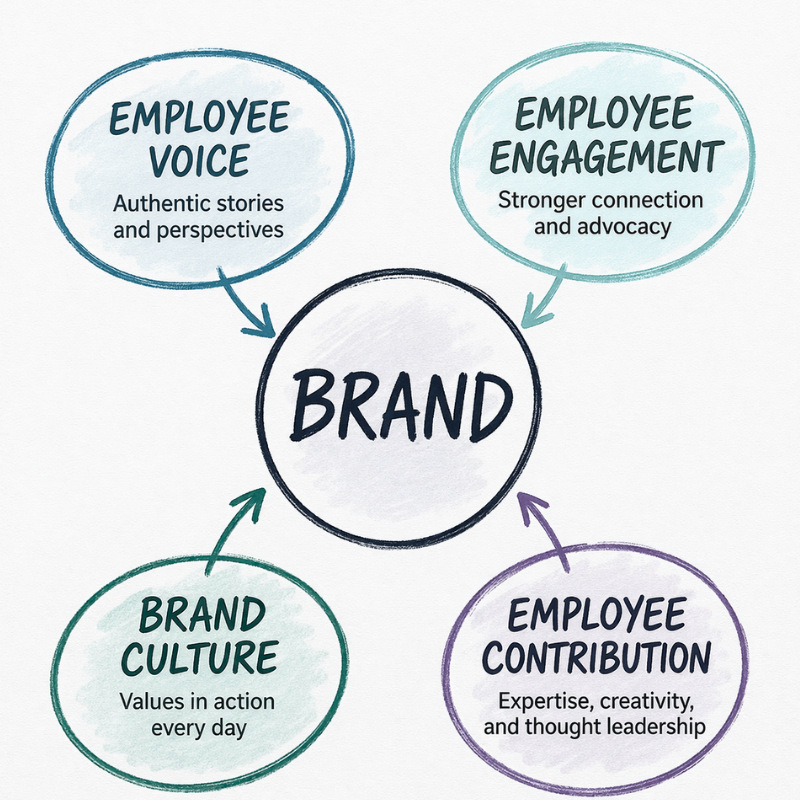
Building Brand Trust from the Inside Out

People buy from, donate to, and trust people. Not organizations.
This reality creates an interesting challenge for faceless organizations that still show up as a logo, a list of services, and a few well-crafted social posts written in a neutral, “brand-safe” voice.
And the risk is only growing as generic content becomes more and more of a commodity with the growth of AI.
Alternatively, the brands that show the thinking, the personalities, and the perspectives behind their work now are the ones that will win tomorrow.
They’re taking one step beyond showing the why behind their work, showing the who.
And one of the most effective ways to get there is also one of the most underused: inviting your team to step into the conversation.
In my experience, owners and managers have shied away from dedicating company resources to propping up team members. I believe that this way of thinking isn’t just outdated, it’s a threat to the future of your business. Here are five reasons why that is – and what you can do about them.
1. Start with LinkedIn. But Make It Human.
Encouraging your team to show up consistently on LinkedIn is one of the fastest ways to expand your brand’s reach and authority.
But the goal is not to turn your employees into corporate mouthpieces. Instead, think of LinkedIn as a place where your team reflects on their work and shares those stories in real time.
What are they learning? What patterns are they seeing in the industry? What challenges are they helping solve?
When employees share those perspectives—through stories—it reinforces something far more powerful than a polished brand post ever could: that your company is full of people who are actively thinking and honing their craft.
And the proof is in the metrics.
In 2025, LinkedIn doubled down on pushing personal page content over company page content.
That means that your team members are your biggest megaphones, whether they’re actively engaging or not.
What does this look like in practice?
Give your team prompts and ideas so they’re not staring at a blank screen. Normalize posts that are thoughtful but not perfect. And most importantly, model it from the top. If leadership isn’t participating, no one else will feel comfortable doing it.
It’s also important to keep in mind that not everyone is ready to jump into posting. Some of your team members will need a runway. Commenting on posts, sharing an article with a quick takeaway, or adding a perspective to existing content may be a more comfortable starting point.
2. Put Your People in the Right Rooms
Getting your team members to serve as extensions of your brand isn’t limited to social platforms.
Some of the strongest signals of credibility come from putting your team in environments where ideas are exchanged in real time—industry panels, webinars, podcasts, small roundtables.
And this is where many companies miss an opportunity. They default to sending the same senior voice every time.
But your brand gets exponentially more interesting when different people step forward. The strategist, the account lead, the person closest to the day-to-day work, and the client—they all have perspectives worth hearing.
When your team becomes known in these spaces, they (and your brand) become a part of the conversation.
3. Turn Internal Thinking Into External Content
I’d bet there are dozens of smart conversations happening every week that never leave the office – or Zoom calls.
That’s a missed opportunity.
The debate that unfolded in a team meeting, the unexpected client challenge, the insight someone shared in Slack—these are all raw materials for meaningful content.
When you start capturing and shaping those moments into blog posts, articles, or even short-form insights, you’re not creating content from scratch. You’re simply extending the thinking that’s already happening.
4. Make Your Team Visible Beyond Their Job Titles
Timid brands simply show who works at the organization. Strong brands show how their people think.
That may look like short videos where team members explain their approach to a challenge, behind-the-scenes glimpses into how work gets done, or storytelling around client engagements that highlight individual contributions.
The goal isn’t to create mini-celebrities. It’s to create familiarity.
Because when a potential client recognizes your team before the first sales meeting, trust builds faster, and sales conversations get easier.
5. Build a Culture Where Sharing Is Normal
If posting, speaking, or contributing ideas feels like “extra work,” it won’t stick. But if sharing becomes part of how your team operates – how they celebrate wins, how they support each other, how they exchange ideas – it starts to feel natural.
And when employees engage with each other’s content, highlight a teammate’s perspective, or add to a conversation already in motion, results compound.
Moving Beyond the Why to the Who Becomes a Win-Win for Your Brand and Your Team
When you pull each of these five efforts together into one approach to building brand trust, your organization gains visibility, credibility, and a clear point of differentiation in a crowded space.
Your team gains confidence, a stronger professional identity, and a sense that their voice matters.
And your audience gets something rare: a brand that doesn’t just talk at them, but shows up through a range of perspectives that actually feel human.
If you’d like a little help pulling a team-focused brand trust strategy together, our team is here for you! Let’s Chat.