

Too many organizations are stuck playing a rigged brand storytelling game. They create content, release it into the world, hope it performs, then scramble to do it all over again the next week.
Meanwhile, social algorithms change overnight, earned media is harder to secure, and attention is scattered across platforms you don’t control.
The solution isn’t to “make more content.” It’s to build a storytelling distribution strategy—a repeatable system that turns every story into multiple touchpoints, across the channels your audience actually uses, mapped to your marketing and sales funnel, and in a way that compounds over time.
Shifting from a Content Creator Mindset to a Content Distributor Mindset
Most brands approach storytelling like a series of one-off campaigns. They invest heavily in production and creating story assets only to distribute the story once and move on.
When we take this approach, we’re naively assuming that one story will earn us our audience’s trust. In reality, brand trust is built through a narrative of emotionally resonant stories told over time.
Which is why every story needs multiple audience touchpoints before it sticks. A distribution strategy will help ensure your stories don’t disappear after one post and instead become a growing system that drives awareness, trust, and action over time.
The Storytelling Distribution Framework: Create Stories, Then Multiply Reach
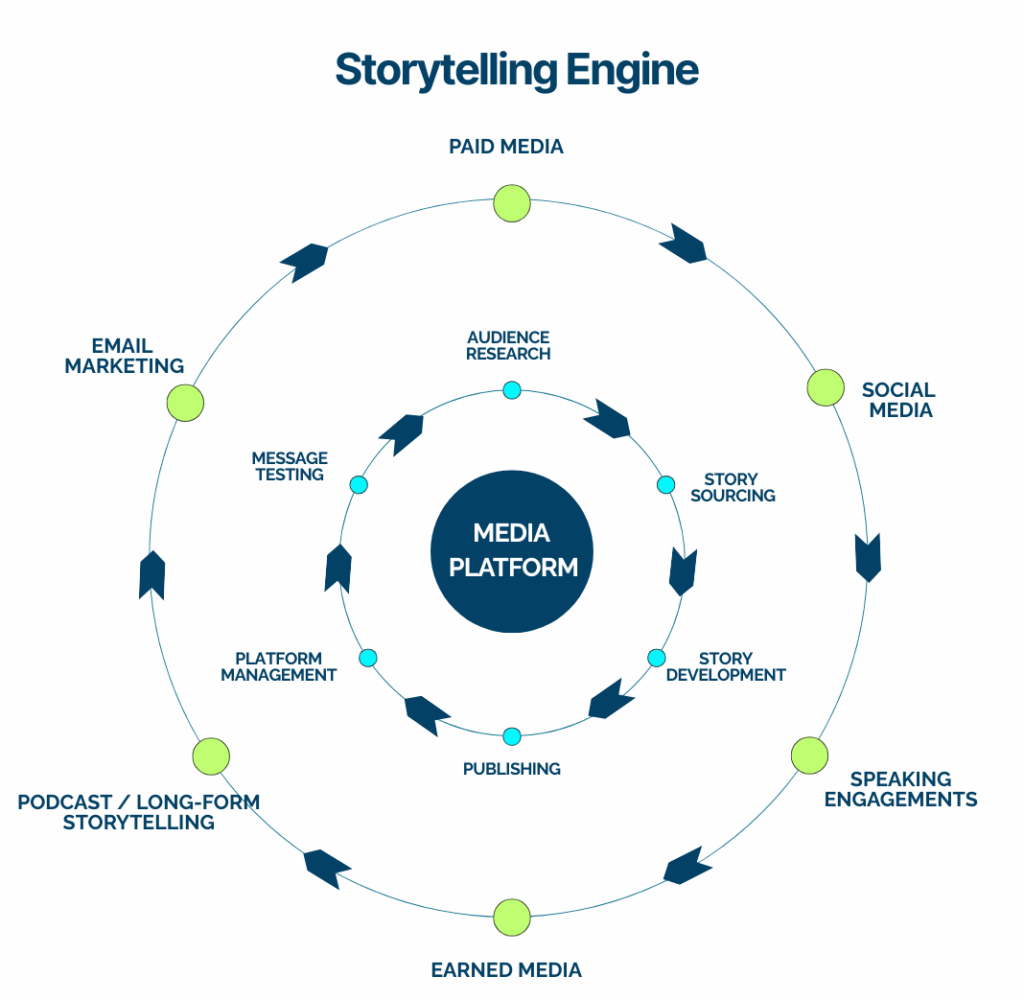
You can think of storytelling distribution as a flywheel.
The inner circle of the flywheel is story creation—the strategic work that makes distribution possible. Think of this as your content hub: the place where you develop stories that are emotionally resonant, message-aligned, and audience-aware.
The story creation phase includes:
- Audience research (who you’re trying to reach and what they care about)
- Story sourcing (the raw moments, proof points, and perspectives worth sharing)
- Story development (turning real material into a narrative with a purpose)
- Publishing (creating the core asset: video, article, podcast, event, etc.)
- Platform management (organizing your hub so content is easy to access and build on)
- Message testing (learning what language and angles actually land)
The outer circle of the flywheel is the distribution phase—the intentional system that pushes your story into the world and pulls people back into your ecosystem.
That distribution includes multiple channels working together:
- Social media (discovery + engagement)
- Email newsletters (consistent reach + owned audience)
- Paid media (amplification + targeting)
- Earned media (credibility + third-party validation)
- Policy outreach and partner outreach (direct influence)
- Webinars and speaking engagements (depth + trust-building)
When these channels work in sync, your strategy gains momentum. Stories don’t disappear after one post—they get repurposed, reintroduced, and reinforced. Every story builds a larger library. Every campaign generates new insights. And each distribution cycle strengthens the next one.
That’s the flywheel effect.
Map Storytelling to the Sales Funnel
Distribution isn’t about being everywhere — it’s about being in the right place, in the right way, in front of the right audience.
That’s where your storytelling distribution strategy meets your sales funnel.
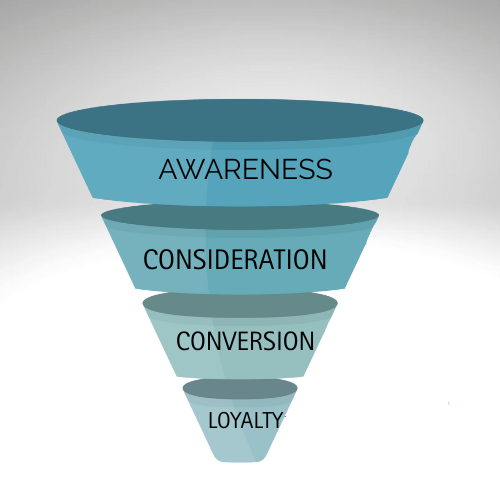
A typical communications funnel moves an audience through:
Awareness → Consideration → Conversion → Loyalty
The smartest brands don’t tell one story one way. They tell versions of a story that match what the audience needs at each stage.
Read our article on Telling Your Story At Every Stage of Your Sales Funnel for a deeper dive into this critical piece of the marketing strategy puzzle.
Own Your Content & Take Back Control of Your Storytelling Strategy
‘Control’ is the name of the storytelling distribution game. When you make the shift from a content creator mindset to a content distributor mindset, what you’re really doing is engineering a system you control, always with the intent to move your audience from platforms you don’t own (social media, traditional media, streaming) to platforms you do own (email, website, etc.)
If your storytelling strategy lives primarily on social media, or in the hands of the press, or on streaming platforms, you don’t own your audience.
This lack of control is a liability.
Social media and long-form streaming platforms are rented land. They can change their algorithms, throttle your reach, suspend accounts, or fade into irrelevance overnight.
Earned media is borrowed attention. You place the power of frequency and message into the hands of editors and reporters, who decide which stories run, when they run, and whether they see the light of day at all.
We’re not saying these channels aren’t valuable. Social and traditional media are KEY channels at the top of your marketing funnel for driving awareness and discoverability.
But you can’t put all of your eggs in a basket you don’t own.
Instead, treat these unowned channels as your ‘feeder system’ for moving new audiences into your owned channels — your website, your email list, and your content hub.
When your storytelling engine is rooted in owned assets, you build a direct line to your ideal audience. You’re not chasing attention. You’re controlling access, controlling message, and controlling momentum—while using social and earned media as accelerators, not dependencies.
The Goal: Reach the Right Audience and Move Them From Awareness to Purchase to Loyalty
With the right distribution strategy, you can reach exactly who you want to reach and move them intentionally from awareness to trust, from trust to purchase, and from purchase to loyalty. Over time, that becomes the real competitive advantage: strong customer relationships built on purpose—one story at a time.
No more posting and praying. No more reinventing every month. Just a storytelling system that builds reach, deepens relationships, and drives measurable action—again and again.
Want to Build a Distribution Strategy Built for Your Brand?
If you’re creating great stories but struggling to build momentum, we help brands build storytelling engines that connect story creation to distribution and funnel strategy—so your content compounds and drives real action.
Want to talk about what that could look like for your organization? Let’s chat!