
As a marketer, one of the best parts of taking on a new client is getting the chance to dive into a business you know nothing about.
That was certainly the case last spring when Fetterville Pole Buildings came to us looking for social media strategy and account management.
Like a lot of trade businesses, their social pages had become what so many do: a portfolio. Project photos, completed buildings, rinse and repeat.
Their social media showed what Fetterville built. It didn’t show who Fetterville was. And they knew it.
The Origin Story Always Comes First
The first month was spent listening and researching.
We audited Fetterville’s existing social presence, sat down with company leadership, and interviewed the owner about the company’s origin story and heard about the family history. We got to know the culture and understand its values.
We learned all about pole barn construction: the process, the materials, the styles, the features. We met the designers and craftsmen who actually make the projects happen.
The more we gathered, the clearer it became: Fetterville was so much more than a photo of a finished building could ever show. That’s where storytelling had to start.
Reframe the Question
Instead of asking “What did you build?” we started asking who dreamed it up, why they built it, and what life looks like inside it now.
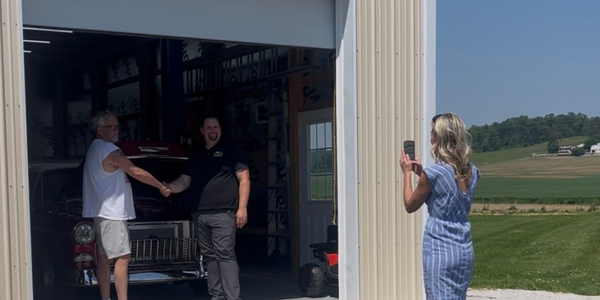
The garage project is where that shift showed up first. It was a hobby-style garage built at a customer’s home, and if we’d approached it like typical project content, we could have taken some beautiful photos, listed a few features, and called it a day.
Instead, we went to the property and talked to the people closest to the story.
We interviewed the homeowner, who’d built the garage as a place to work on his classic cars. We captured the collection, the tools, equipment, and the details of the finished space.
But we also interviewed the Fetterville salesman who had worked with him throughout the entire process. From the first phone call and design conversations, through construction, to the finished building. Even when the homeowner needed a last-minute roof on his shed.
Put the two of them together on camera, and you didn’t need a script to tell viewers that Fetterville values its customer relationships. You could simply see it.
They laughed. They talked about each other’s families. They spoke about one another like people who actually knew each other (because they did).
That’s the kind of authenticity that’s hard to manufacture, and it’s far more powerful when you don’t have to.
Watch the first video here
One Story Becomes Many
That one visit gave us more than a single social post. The interviews, photography, and B-roll turned into multiple Reels, each telling a different piece of the story.
The craftsmanship was still there. The finished project was still beautiful. But now there was a reason to care about it.
Viewers were seeing more than a pole building. They were meeting the person who dreamed up the space, understanding why he wanted it, and seeing the relationship that helped bring it to life.
The product hadn’t changed. The way people experienced the brand had.
And audiences responded. As Fetterville’s new strategy rolled out with customer stories and emphasis on the why behind its buildings, that month’s social performance showed significant month-over-month growth.
On Facebook, organic views were up 67%, content interactions up 172%, and watch time up 147%. On Instagram, organic views climbed 81%, interactions jumped 178%, and reach grew more than 1,000%.
Those numbers are worth celebrating. But more importantly, what they’re telling us is that people are interested in the stories behind the buildings.
Humanizing Your Brand Doesn’t Mean Forcing It
There’s a misconception about what it actually takes to humanize a brand. It’s not about turning every employee into an influencer or chasing whatever trend is performing this week. It’s not about sticking someone in front of a camera just because faces “perform better.”
It’s about getting closer to the people who already know the stories.
Your customers know what changed because of your work. Your employees know what it takes to deliver it. Your salespeople know the conversations that happen before anyone signs a contract. Your founders know why the company exists in the first place.
The best brand stories are usually sitting right in front of you.
When marketers take those authentic experiences and pair them with an intentional storytelling strategy, the company stops feeling like a product and content stops feeling like marketing.
Give your audience a chance to look inside your business and get to know the people behind it. That’s how a brand becomes more human, and it’s where trust begins.